Blood Money – The Insurance Business

There are a few people whom I know that have a business and don’t use a website, but it would be like having a religion and not having a “Big Book” or “Basic Text”, or a 12-Step program without the 12-steps. When I first started A History of Blood, I just wanted a way to document my family history and talk about my experience in the military. Over time, I wanted something more specific to my career as a whole, especially the work I’ve done, and am still doing as an insurance agent. I wanted a story that would allow me to spinoff the main story, crossover or otherwise create a cinematic universe (of Blood) or have all my stories stories run parallel, without having them be exactly the same thing.
While the story of A History of Blood formally begins on August 24, 1791, with the beginning of the Haitian Revolution, the story of Blood Money officially begins on January 11, 2025, the day I first obtained my Life & Health Insurance License. Both stories fall into the category of historical fiction.
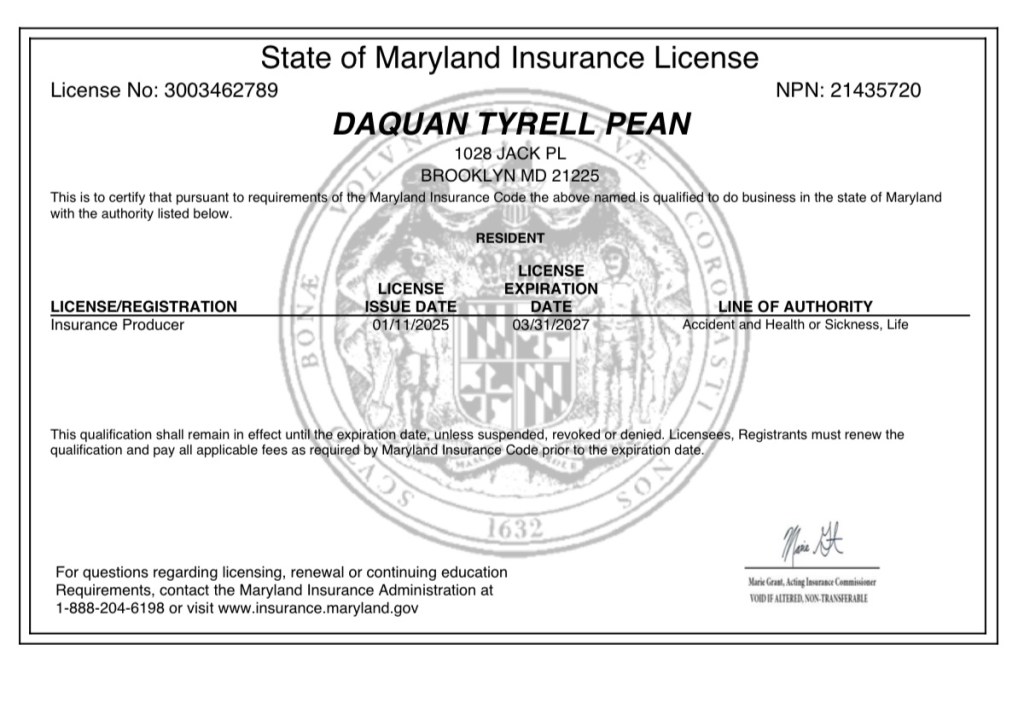
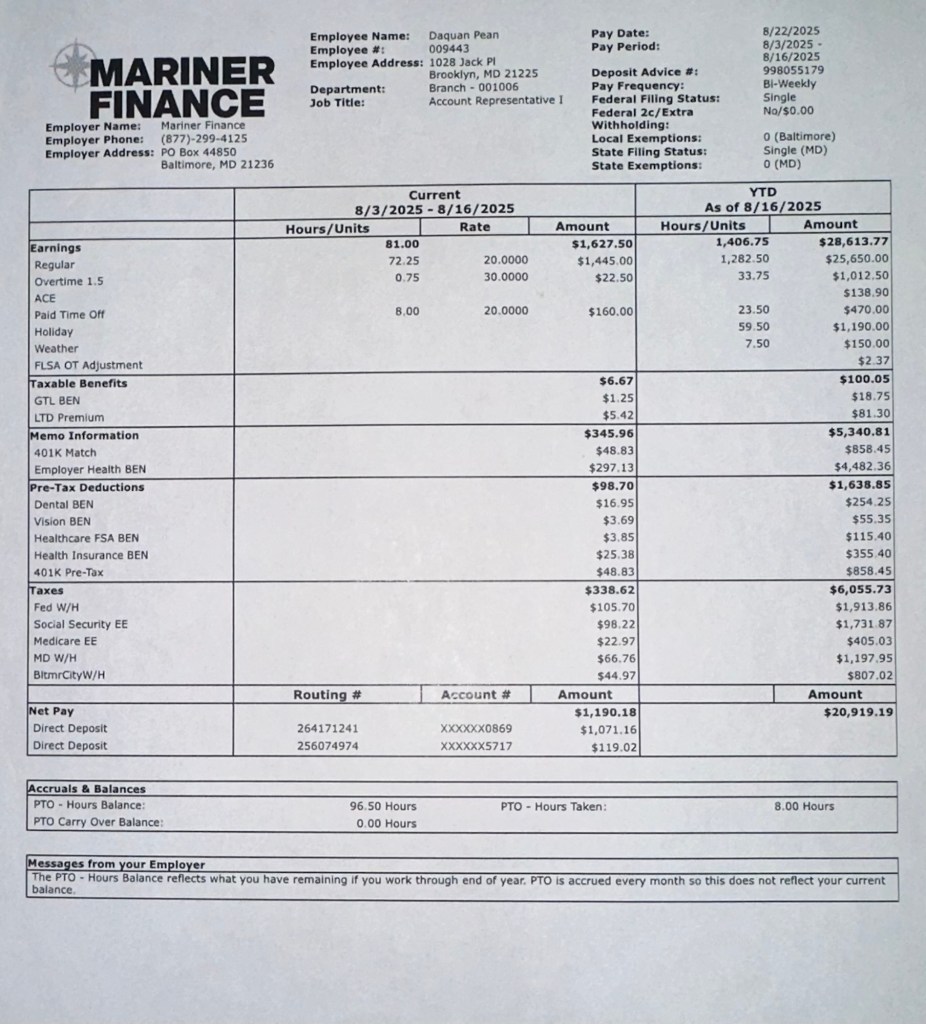
Since getting my insurance license, my life has been all over the place. The first 8 or so months were great, as I made $28,563 from January to August (an average of $3,570 per month), after which my life completely fell apart.
On August 25, 2025 at approximately 8:14 AM, I witnessed the death of Jaime Allison Morgan. She died in the ICU of Baltimore Washington Medical Center in room 262. She was born on May 23, 1996, and was only 29 years old at the time of her death. Her family received an undisclosed life insurance payout for her death, with her organs being donated to charity.
Jaime was an Insurance Agent whom I had the luxury of working with. We both worked together at a Finance company, using our insurance licenses to sell personal loans with AD&D (Accident Death & Dismemberment) insurance. We also sold other types of insurance such as credit life, involuntary unemployment insurance, and disability insurance. We didn’t actually earn commissions on the policies sold so I didn’t keep track of them, and since most of the money we earned came from our salaries we didn’t really worry too much about anything.

Her Maryland Insurance license is still active:
NPN: 21479857
License No: 3003511344
Expiration: 05/31/2027
It will expire eventually, but that’s beside the point. I actually don’t have my Maryland Life & Health License anymore since I’ve surrendered it in exchanged it for my Florida 2-15. By surrendering an exchanging my resident license, I avoided having to take the state exam again, and simply had to pay the required fees and get fingerprinted. I moved to Florida on January 21, 2026, about a year after getting my initial insurance license, and then transferred my license to Florida about two months after that.
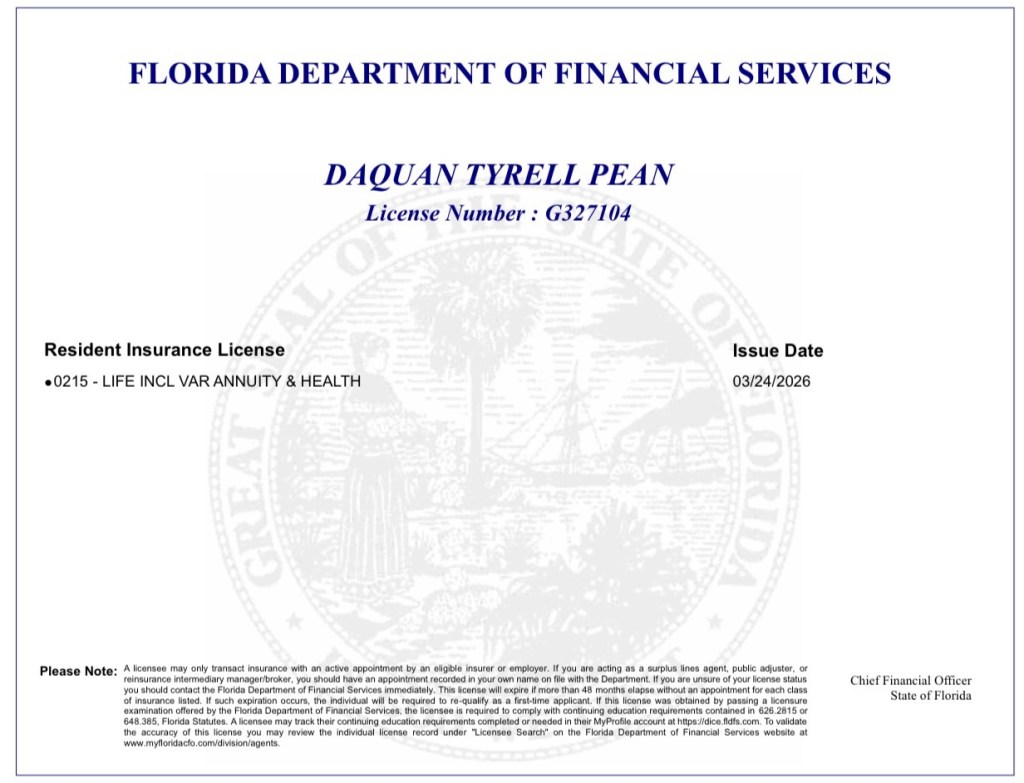
If someone wants to become a Florida 2-15 Health & Life Insurance Agent, the standard path is fairly straightforward. The 2-15 license covers health, life, and annuities, the concepts and application of which will be one of the main subjects of this blog.
Florida 2-15 licensing process
Before we get into the main story, I want to explain some the how, in the unlikely event that someone reads this story and decides to follow in my footsteps. A career in the insurance industry can be very lucrative, has a low barrier to entry, and overall has given my career both direction and a sense of purpose.
1. Meet the basic qualifications
The applicant generally must:
- Be at least 18 years old
- Be a Florida resident
- Be a U.S. citizen or eligible legal alien with work authorization
- Not maintain a resident insurance license in another state
2. Complete the required education
For a typical first-time applicant, the standard route is a 60-hour Florida-approved pre-licensing course covering life, health, and variable annuity insurance. The course must be completed within four years of applying. When I originally started studying for my Maryland Life and Health License (back in 2022) there was a 40 hour requirement, which has actually been lifted as of 2024. It’s worth noting that each state has different pre-licensing requirements.
There are exceptions for certain professional designations, college coursework, and people transferring an equivalent license from another state.
A Chartered Life Underwriter (CLU) is a certified expert on life insurance and estate planning. CLUs are considered the gold standard of education for life insurance planning. They are awarded by The American College of Financial Services and the CLU designation is considered the most respected insurance designation in the industry. It’s among the designations where the pre-licensing requirement is waive, and it’s a designation I’ve been considering working towards.
3. Pass the Florida state examination
After satisfying the education requirement, the applicant takes the 2-15 state exam. Florida currently lists the examination fee as $44 (per attempt)
Florida also offers the 2-15 examination in Spanish.
4. Submit the license application
The applicant creates/uses a MyProfile account with the Florida Department of Financial Services and submits the license application and required fees.
The standard application fee is currently $50, plus a $5 license ID fee. Some military members, spouses, and qualifying veterans are exempt from the application filing fee.
5. Complete fingerprinting/background requirements
Applicants must complete the required fingerprinting/background-check process as part of Florida’s licensing requirements.
6. Get appointed
Getting the license itself isn’t the same as being ready to transact business for an insurer. Florida states that agents must be licensed and appointed to act as insurance agents. For example, after getting a 2-15 license, an agent might obtain appointments with carriers or an appropriate agency/IMO/FMO depending on the products they intend to sell.

I’ve recently switched to a new FMO, and I plan on working on my appointments as soon as I finish the classes I’m working on at the moment.
The Insurance products I sell can be split into three distinct categories:
- Health Insurance (Medicare)
- Life Insurance (Final Expense)
- Retirement (Annuities)
One of the major objectives of Blood Money is to explain or otherwise display case studies of the above. Having your insurance license allows you to do all of the following:
- Work as a salaried captive agent
- Work as an independent agent
- Earn commission
- Help with medical bills
- Help with final expenses / legacy
- Help with retirement
- Build an agency
- Sponsor other agents
- Generating your own leads and business
- Working for established insurance companies
Florida’s Department of Financial Services lists all the fees associated with getting your license, including the $44 exam, $50 application, $5 ID, and $49.50 fingerprint fee. The 2-15 normally requires a 60-hour approved life/health/variable-annuity course unless the applicant qualifies for an exemption.
Plan on roughly $200–$400+ to get started, depending primarily on the price of the pre-licensing course and any study materials.
That’s before considering optional expenses such as exam-prep programs, transportation, business cards, CRM software, lead costs, etc. The budgeting and accounting of that will be the subject of a different day.
Salary.com currently estimates the average Florida Licensed Insurance Agent at approximately $80,229/year, with a 25th–75th percentile range of about $70,445–$90,529.
Indeed currently reports an average Florida Insurance Agent base salary of approximately $79,299/year, based on thousands of job postings, with reported salaries ranging from about $34,930 to $180,027.
Considering that my first year, I made $28,563 over 8 months, it’s safe to assume I would have realistically made $43,000~ if I would have worked the full year.
The biggest difference between a traditional salaried job and working as an independent Medicare/life agent is that commission-based income can vary substantially with production and the contracts/products involved. A new agent shouldn’t assume the statewide “average salary” will be their actual first-year income.
The Florida 2-15 gives you the licensing foundation to work in life and health insurance. The upfront licensing costs are relatively modest compared with many careers, but the license itself doesn’t create income. Your income comes from building a book of business—finding people, educating them, helping them with appropriate coverage, and consistently following up.
In addition to working as an Insurance Agent, I also plan on continuing to work as an Armed Security Guard. My career in Armed Security began with my military service. Similar to the way I had to transfer my insurance license over to Florida, I have to go through the licensing for security as well. I’m actually working on three different licenses as part of my security career.


Leave a comment