A History of Blood – Vol. 3, Chapter 19
A chapter that summarizes all the notes from my first week working with Link Management.

Below is all the notes from Training Days 1-5 while working with Link Management, a project management firm in Tampa, FL. I work with them as an Insurance Agent, teaching sales to their Account Executives and providing employee benefits.
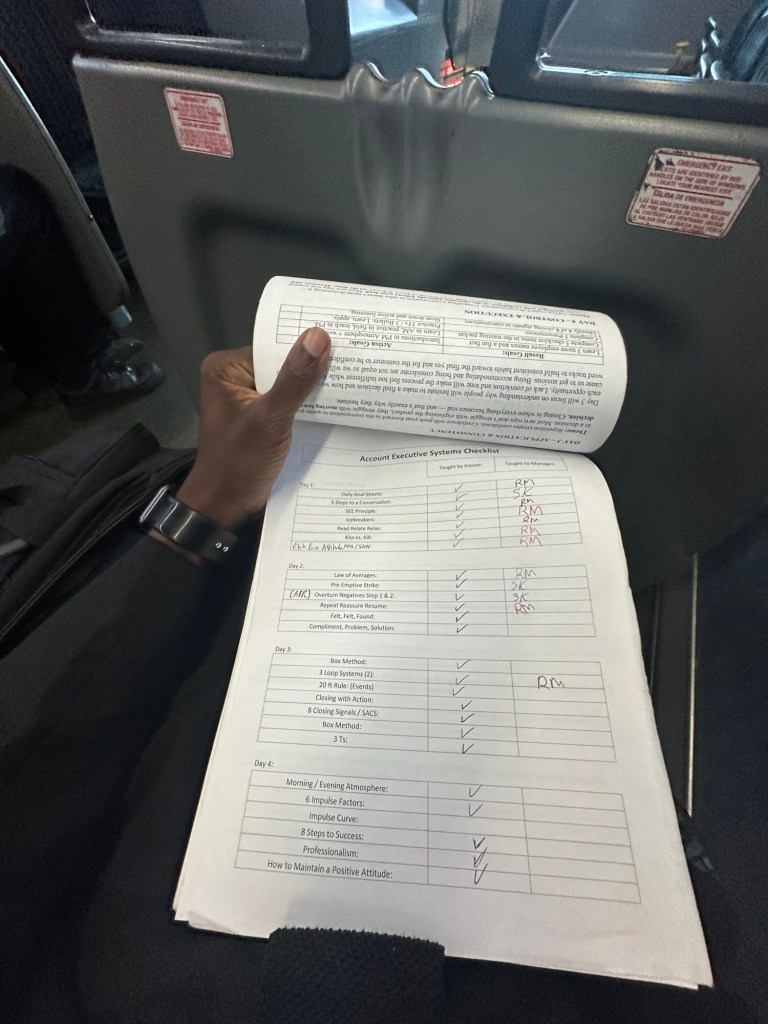
I’m still working on completing my “Systems Checklist”, which is all the sales and marketing concepts that we use both in the Office and in the Field. The entire opportunity at Link Management revolves around the Account Executives learning this system in the office, practicing it in the field, and then teaching it back to the team after the field.
Action Goals: what you plan to do, or the different aspects of the business you plan to focus on.
Some Examples:
- Introductions in Atmosphere
- Learn in AM, Practice in Field, teach in PM.
- Observe, practice, and track with worksheet
- Use AIR, FFF, RRR (Overturn Objections)
- Practice 3 T’s / 3 bullets: Learn and apply
- Insurance Calls / Direct Deposit Access
- Slow down and active listening
Result Goals: how much you plan to do something. Measurable regardless of whether or not they were hit.
- Learn 3 employee names and fun facts
- Complete 5 Checklist items
- Complete Steps 1-3 of the conversation (20 times)
- Identify 3 smokescreens
- Identify 4 closing signals
- 3 Insurance Calls / 3 Direct Deposit Access
- Close 3 deals
Fun Facts: positive subjects to talk about, related to FORDS and current employment. Helps prevent gossip.
Some Examples:
- I have been to Paris, Texas
- I once spent a week in Colombia 🇨🇴
- My Family is from Haiti 🇭🇹
- I served 2 years in the United States Marines 🇺🇸
- I have made 1 TV appearance
- I have not had any drugs or alcohol in 6 months
- I studied graphic design in college
- I own 4 books in languages other than English
- I once read 30 books a year
- I read a lot of Manga
Daily Goals: split into actions and results, gives you something to focus on, something to be excited about, and a way of tracking your progress. (1)
SEE Principle: nonverbal parts of your introduction– your smile, eye contact, and enthusiasm. People buy people first; customers prioritize trust, rapport, and connection with a salesperson over the product or price. (2)
Icebreakers: easiest ways to start the conversation. A sincere compliment, a small joke, or a positive acknowledgment. (3)
Read, Relate, Relax: a strategy used to find an icebreaker; reading the situation, relating the person to and relaxing the conversation, without forgetting to transition back to the pitch. (4)
5 steps to a conversation: the framework for a memorable interaction:
- Introduction: SEE Principles and Names
- Short Story: 5Ws and Qualifying Questions
- Presentation: Review of Product or Service
- Close: Pen to Paper or Start the Call
- Rehash: Managing Expectations and Next Steps
KISS vs. KILL: keeping conversations about products and services short and simple, keeping conversations about FORDS long and lengthy, but waiting after starting the closing process before doing so. (6)
PPA vs. SAW: in order to obtain duplicatable results, you must maintain your attitude, use a consistent pitch, apply the systems (including tracking sheets), and control your pace. The faster your pace the faster you’ll obtain results, but it’s important not to tire or burn yourself out. (7)
FORDS: conversation guide. Helps prevent gossip.
SMAC: guidance for goal setting. Gives you something to focus on.
QTQP: only spend time with qualified buyers or quality candidates.
Preemptive Strike: addressing an objection before the customer; not leaving any important information out. (8)
AIR: used when the customer says “I’m good” or “I’m not interested” or if they interrupt you during steps 1-2 (9)
RRR: used when the customer says “they are busy” (10)
FFF: used when the customer says they have had a bad experience (11)
CPS: used when the customer is procrastinating. (12)
Law of Averages: more is more; more action leads to more results (13)
Box Method: tight to the right; strategy for working territory correctly and working it as a team. (14)
20 ft rule: wave to anyone within 20 feet, don’t start the short story until about 6 feet
Closing with Action: don’t wait for the customers permission if they have already given you their information and you are acting in their best interest.
Qualifiers: criteria to sell a customer a product or service; varies per campaign (15)
Verbal vs. Physical: different closing signals a customer will give you. Some are expressed such as the verbal signals, others are implied such as the physical signals. These are signs to start the closing or qualifying process if you haven’t already. (16)
Closing Signals: (17)
- Want & Need (Expressed Desire)
- Love & Hate (Intense Emotions)
- Asking Questions
- Taking Ownership (doing it for you)
- Silence
- Competitor Bashing
- Body Language (Nodding)
- Familiar with products or process (just needs CPR)
SACS: change the subject once the closing process starts. (18)
3 Loop System: strategy for controlling your pace, working your territory correctly, and working a full day, ensuring consistent communication with qualified prospects and no sales opportunities are missed.
- Early Birds: 11-1
- Lunch Rush 1-3
- Power Hour: 3-6
6 Impulse Factors: strategies to move the conversation forward
Fear of Loss: personalize service (CPR)
Urgency: getting it done quickly
Greed: sweeten the deal
Indifference: stay calm (don’t get too excited)
Effect of Jones: include others
Suggestion: multiple choices
Impulse Curve: starting the closing process at the height of impulse, which is immediately after the presentation. Utilizing the Rehash after the closing process, in order to prevent buyers remorse.
Professionalism: respectful behavior with technical proficiency, honest and ethical conduct– choice of words, posture and poise, way you dress.
3 Ts (3 Bullets): Major plot points
- Why I’m here (or why I called)
- Best part
- Why people chose us
WHY
- No Cost Windshield Replacement
- Financial Technology, Fee-Free Banking
- Life Insurance and Annuities
- Promotional Sales, Marketing, and Events
BEST PART
- We come to you
- $200 bucks, no credit check
- Legacy and Lifestyle
- The Opportunity and the Culture
CHOOSE US
- Lifetime Warranty, Local Company
- Easy Money, Better Accounting
- Dedicated Agent, Multiple Carriers
- Rapid Advancement and Amazing Culture
8 Steps to Success: general guidelines for your behavior and personal development.
- Be Positive
- Be on Time (Early)
- Be Prepared (Goals)
- Work your full 8 (LOAs)
- Manage your Territory (A,B,C)
- Maintain Positivity
- Know your Where and Why
- Take Control
Morning & Evening Atmosphere: basic schedule— learn in the morning, do in the afternoon, review in the evening.
Morning = Networking & Goals
Field = Practice & Tracking
Evening = Breakdown & More Networking
How to Maintain a Positive Attitude: know your process, numbers, and people.
- Production and Promotion Requirements
- Training Checklists and Tracking Sheets
- Current and Upcoming Events
I want to make this the week I get promoted. That way I can start promoting other people and stop worrying about what’s going on around me.
 🩸
🩸 
Leave a comment