A History of Blood – Vol. 3, Chapter 15
I had a business meal and checked out two office spaces, before realizing my current career trajectory.

So today I checked out two different businesses which both had really cool concepts. The first was a Consulting Company that I’ll likely partner up with and the second turned out to be one of my competitors.
As an Insurance Agent, I sell life insurance and annuities. I work mostly by referral, and tend to focus on financial education, social programs, and personal relationships.
The average Consulting Company hires, trains, and expands sales and marketing campaigns. They usually focus on one of four channels, or campaign types:
- Residential (aka Door to Door)
- Commercial (aka Business to Business)
- Retail & Events (aka Tabletop or “Pop-up”)
- Lead Generation (Appointments & Live Transfers)
I was reviewing the documentation the Consulting Company gave me when I realized I had finally solved my biggest problem in the Insurance Business.
There are three major barriers to entry when it comes to being successful as a new Insurance Agent, or as a new agency owner.
The first is the cost of licensing. It costs about $600~ to get your initial license, assuming you pass the time on the first try, it costs about $60-$70 for every additional state in which you need a license, and your resident and non resident licenses need to be renewed every 2 years. In addition to the monetary cost, there’s the opportunity cost of having to actually study and pass the state exam, on top of the continuing education. This is the biggest hurdle to recruiting in the insurance space.
A Consulting Company essentially helps cover the startup costs by monetizing the period between an agent getting started and getting licensed.
The next second big issue is the cost of leads. Generally, there are two ways to generate leads. The first way is the old fashioned way or the preferred way: investing in the relationship with the customer by supporting their business, or treating them to a meal or social event.
I’ve done deals at sporting events, I’ve done deals over coffee, deals over lunch, dinner, or even alcoholic beverages. I’ve traveled to meet prospects face to face when they are tricky to get over the phone, and I’ve invested into both my personal appearance and print marketing materials to give me the highest possible chance of impressing the customer, all for the sake of impressing them, earning their business, and garnering referrals.
It’s very to buy leads and waste a lot of time and money working them, as the quality of them is variable, which is why I try to generate my own.
The Consulting Company directly helps with that by generating leads at a somewhat reasonable cost, while also making sure they are exclusive, and high quality.
The last big issue is the cost of the office space, and related hardware and software, such as microphones, cameras, computers, headsets, printers, etc. The image of the office is important, especially since it also functions as a “studio” for advertisements. The same can be said about the “fleet”, but it can be tricky when deciding which vehicles to purchase for business purposes. Flashy vehicles make better adverts, but high capacity vehicles tend to be more practical. I’m sure the best answer is somewhere in the middle. Anyways.
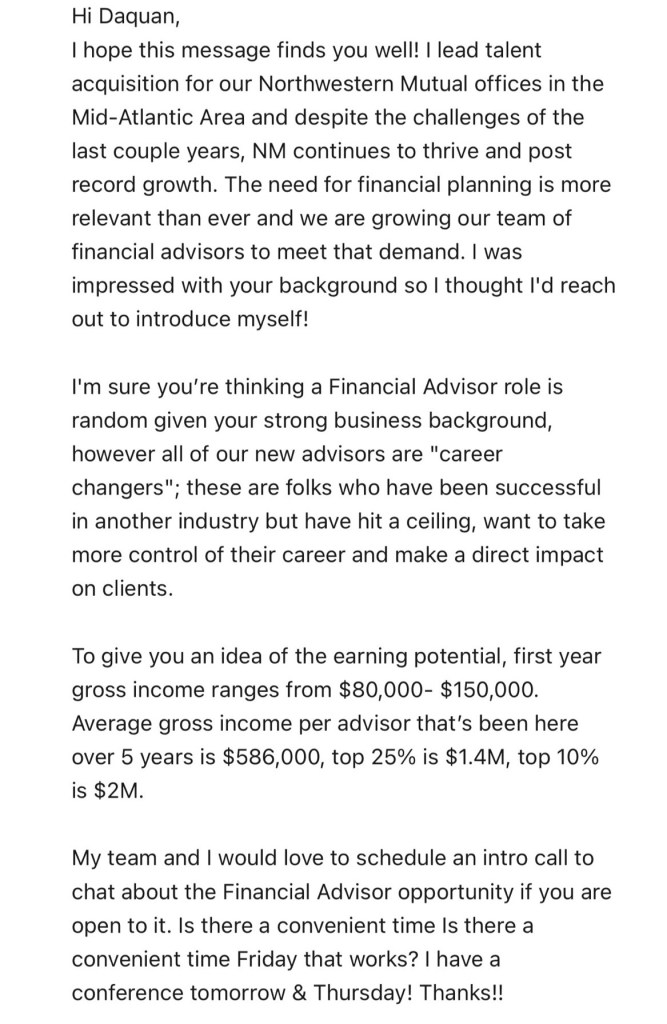
The above is an example “introduction letter” from one of my competitors. It was really well written and I did eventually go in for the interview, where I was also impressed. They were the ones who actually taught me how to generate leads based on an understanding of this:
The average cost of a life insurance lead typically ranges from $20 to $150+, heavily influenced by exclusivity and real-time delivery. Shared leads are cheaper ($20–$45), while exclusive, real-time leads can cost $80–$200+. Aged leads (30+ days) are available for $1–$15, with higher ROI potential.
So, instead of spending $20-$150 on purchasing the information from a vendor, you invest $20-$150 on the relationship with the prospect.
That $20-$150 can be lunch/dinner, tickets to a concert, a trip to the gun range, etc. Ideally it’s something the prospect (and agent) are mutually interested in, which is why food and sports tends to be such popular choices.
 🩸
🩸 
Leave a comment