A History of Blood – Vol. 2, Chapter 8
10th of Shevat, 5786
After moving to a new city and endeavoring to use my God-given name for all intents and purposes, I decided to continue my career as an Insurance Agent, continue my work as a Priest, and aspire to become a Politician rather than directly continue my military career.

What do you call Black Mormonism?
The Church of Jesus Christ of Latter-day Saints in Haiti refers to the Church of Jesus Christ of Latter-day Saints (LDS Church) and its members in Haiti.
My family (the Pean family) came to the United States of America from Haiti sometime in 1977.
On September 30, 1978, at the 148th Semiannual General Conference, the LDS Church released a statement that would become known as Official Declaration #2, based on a letter sent earlier that same year, which read as follows:
June 8, 1978
To all general and local priesthood officers of The Church of Jesus Christ of Latter-day Saints throughout the world:
Dear Brethren:
As we have witnessed the expansion of the work of the Lord over the earth, we have been grateful that people of many nations have responded to the message of the restored gospel, and have joined the Church in ever-increasing numbers. This, in turn, has inspired us with a desire to extend to every worthy member of the Church all of the privileges and blessings which the gospel affords.
Aware of the promises made by the prophets and presidents of the Church who have preceded us that at some time, in God’s eternal plan, all of our brethren who are worthy may receive the priesthood, and witnessing the faithfulness of those from whom the priesthood has been withheld, we have pleaded long and earnestly in behalf of these, our faithful brethren, spending many hours in the Upper Room of the Temple supplicating the Lord for divine guidance.
He has heard our prayers, and by revelation has confirmed that the long-promised day has come when every faithful, worthy man in the Church may receive the holy priesthood, with power to exercise its divine authority, and enjoy with his loved ones every blessing that flows therefrom, including the blessings of the temple. Accordingly, all worthy male members of the Church may be ordained to the priesthood without regard for race or color. Priesthood leaders are instructed to follow the policy of carefully interviewing all candidates for ordination to either the Aaronic or the Melchizedek Priesthood to insure that they meet the established standards for worthiness.
We declare with soberness that the Lord has now made known his will for the blessing of all his children throughout the earth who will hearken to the voice of his authorized servants, and prepare themselves to receive every blessing of the gospel.
Sincerely yours,
Spencer W. Kimball
N. Eldon Tanner
Marion G. Romney
The First Presidency
The first member of the church in Haiti, Alexandre Mourra, a storekeeper, wrote a letter to Richard L. Millett, president of the church’s Florida Ft. Lauderdale Mission, requesting a copy of the Book of Mormon after he read a pamphlet about Joseph Smith.
The Book of Mormon teaches that “all are alike unto God,” including “black and white, bond and free, male and female” (2 Nephi 26:33). Throughout the history of the Church, people of every race and ethnicity in many countries have been baptized and have lived as faithful members of the Church. During Joseph Smith’s lifetime, a few black male members of the Church were ordained to the priesthood. Early in its history, Church leaders stopped conferring the priesthood on black males of African descent. Church records offer no clear insights into the origins of this practice. Church leaders believed that a revelation from God was needed to alter this practice and prayerfully sought guidance. The revelation came to Church President Spencer W. Kimball and was affirmed to other Church leaders in the Salt Lake Temple on June 1, 1978. The revelation removed all restrictions with regard to race that once applied to the priesthood.
After reading the book, Mourra traveled to Florida and was baptized on June 30, 1977. He then shared his findings on the church and on July 2, 1978, Millett and his counselors traveled to Haiti to preside over the baptism of 22 Haitians near Port-au-Prince.
The first four full-time missionaries were transferred from the Paris France Mission and to Haiti in May 1980. The first branch was established that October, with Mourra as president. On December 19, 1982, the Haiti District was created.
On November 29, 1983, selections from the Book of Mormon were published in Haitian Creole. In 1999, the complete translation of the Book of Mormon was published, followed by the translation into Haitian Creole of the Doctrine and Covenants.
The Pearl of Great Price was published in July 2007. By that time, all church congregations were led by local members rather than missionaries.
At the church’s April 2009 General Conference, Fouchard Pierre-Nau, a native of Jérémie, was called as an area seventy in the church’s Fourth Quorum of the Seventy, the most prominent church position ever held by a Haitian up to that time.
Most of the church’s buildings sustained little to no damage in the 2010 Haiti earthquake.
Church buildings became temporary hospitals and shelters during the aftermath of the quake. Several church members from Haiti, the United States, and other nations assisted with the medical, cleanup, and rebuilding that occurred following the quake. The church also provided substantial relief in the aftermath of Hurricane Hanna and other tropical cyclones.
The Port‑au‑Prince Haiti Temple is a temple of the Church of Jesus Christ of Latter-day Saints located in Pétion‑Ville, a suburb of Port‑au‑Prince, Haiti. It was announced by church president Thomas S. Monson on April 5, 2015, during general conference. It is the first temple in Haiti, the second in the Caribbean, and the church’s 165th operating temple worldwide.
The temple is on a 10,396-square-foot (0.24-acre) property in Pétion-Ville, with tropical gardens planted with palm trees, shrubs, and sod. The temple’s exterior has a limestone façade. The interior has one ordinance room and one sealing room. The design includes Swarovski crystal chandeliers (from Austria), with Venetian hand-blown glass fixtures in the bride’s room.
The design merges ceremonial functionality with Haitian motifs, such as tropical plant life and native color schemes, including the hibiscus—Haiti’s national flower—and palm leaves woven into the carpets, art glass, and upholstery. These use a palette of turquoise, lime green, blue, and gold.
The intent to construct the Port‑au‑Prince Haiti Temple was announced by church president Thomas S. Monson on April 5, 2015, during the general conference, with the Abidjan Ivory Coast and Bangkok Thailand temples announced at the same time. At a stake conference on March 12, 2017, apostle Neil L. Anderson announced the location for the temple would be behind the existing Route de Frères meetinghouse.
A groundbreaking ceremony occurred on October 28, 2017, with Walter F. González, a general authority who was president of the Caribbean Area. It was attended by local community leaders, including the mayor of Pétion‑Ville
A public open house was held from August 8 through August 17, 2019 (excluding Sunday).
In conjunction with the temple’s dedication, a youth devotional was held on August 31, 2019, in Port-au-Prince, where apostle David A. Bednar encouraged Haitian youth to embrace temple worship as a source of spiritual strength and identity.
Member participants expressed that visiting the temple and attending the devotional deepened their faith and increased their pride in being Latter-day Saints.
The Port‑au‑Prince Haiti Temple was dedicated by Bednar on September 1, 2019, with three sessions held.
At the time of its dedication, the temple district included the five stakes and four districts in Haiti, with approximately 24,000 members.
The temple is the church’s first in Haiti, second in the Caribbean, and 165th worldwide.
In 2020, like all the church’s others, the Port-au-Prince Haiti Temple was closed for a time in response to the COVID-19 pandemic.
On August 14, 2021, a 7.2 magnitude earthquake struck Haiti, but the temple was not damaged.
The church’s temples are directed by a temple president and matron, each typically serving for a term of three years. The president and matron oversee the administration of temple operations and provide guidance and training for both temple patrons and staff.
Serving from 2019 to 2023, Fritzner A. Joseph was the first president, with Marie-Gina M. Joseph serving as matron.
He was previously president of the Haiti Port-au-Prince Mission and was also one of the church’s first Haitian full-time missionaries.
On June 24, 2019, the church announced the public open house that was held from August 8 to August 17, 2019.
The temple was dedicated on September 1, 2019, by apostle David A. Bednar. Like all the church’s temples, it is not used for Sunday worship services. To members of the church, temples are regarded as sacred houses of the Lord. Once dedicated, only church members with a current temple recommend can enter for worship.
As of 2023, Hubermann Bien Aimé is the president with Maggy L. Bien Aimé serving as matron.
As of December 31, 2024, there were 25,793 members in 50 congregations in Haiti.
A History of Blood
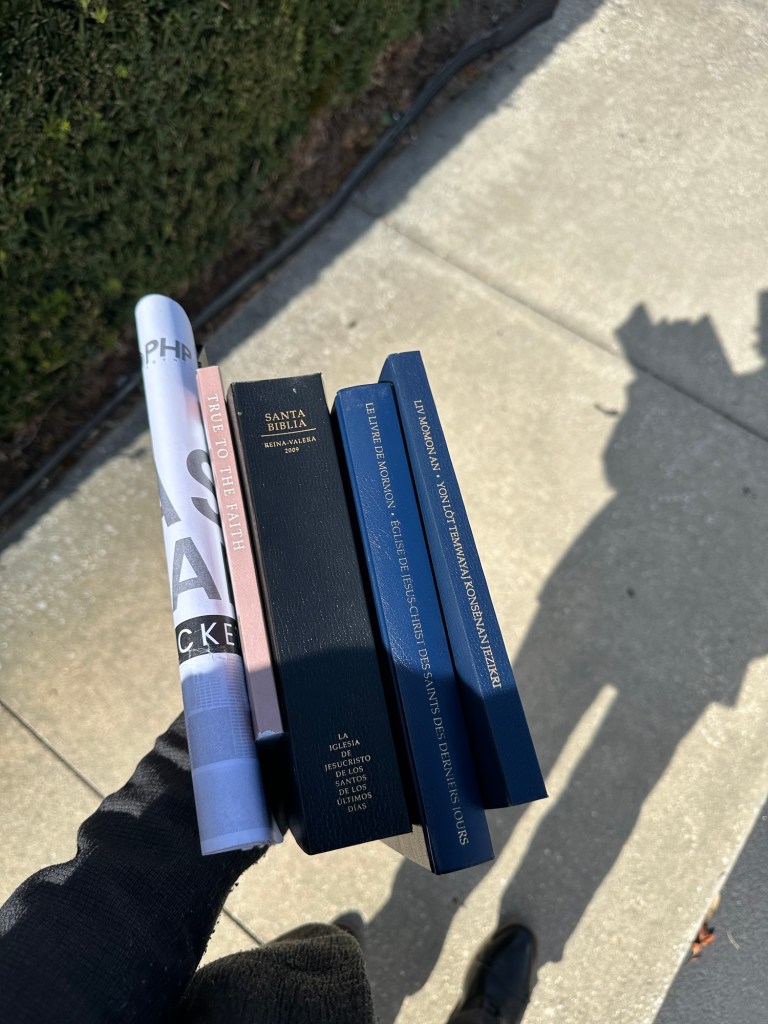
The Book of Mormon would be the first book I’ve ever owned in Haitian Creole. Growing up in foster care and away from my family, I had little to no exposure to our history or culture, outside of my own research which amounted to excerpts of a few autobiographies, a few internet articles, and some fairly interesting documentaries.
It is a luxury to be able to view the History of Haiti from the lens of being born in America, especially when you factor in my service with the United States Marines, and how the Marines invasion of Haiti started a chain reaction of events.
It all began on July 28, 1915 when 330 United States Marines landed in Port-au-Prince. Upon arrival, the Marines shot and killed a rebel right away.
At that time, there was an 8 year old boy in Port-au-Prince named Francois Duvalier.
The Marines would occupy Haiti from 1915 until 1934, creating a militia known as the Gendarmerie of Haiti. When the Marines departed, the Gendarmerie would essentially become the Indigenous Army, the original name for the Haitian Armed Forces.
In October 1950, Haiti held it’s first direct elections. A man named Paul Magloire was elected, and served as the President of Haiti from December 6, 1950 to December 12, 1956
The next elections were held on September 22, 1957 with Francois Duvalier winning with 680,509 or 72.36% of the votes.
Following an (unsuccessful) coup attempt in 1958, Duvalier would form the VSN, or Volunteers of the National Security, also known as the Tonton Macoute, a paramilitary component of his Political party, the “National Unity Party” or “PUN” based on its name in French: Parti de l’unite Nationale.
In 1963, he would outlaw all other political parties, and the following year, on June 14, 1964, he would write a new constitution, consolidating the legislature to a single body, changing the colors of the flag from red and blue to red and black, and most importantly; declare himself President for life with the Power to name his successor, formally beginning the Duvalier Dynasty.
Francois Duvalier died on April 21, 1971, and was succeeded by his son, Jean-Claude Duvalier.
My mother was born in Haiti a few years after that, on August 3, 1976, and the following year my family fled to the United States, specifically New York City in 1977.
Our emigration was followed by Official Declaration 2 in 1978, which was then followed by the formation of the Church of Jesus Christ of Latter-Day Saints in Haiti in 1980.
For the sake of comparison, I was born in the United States, specifically Manhattan, New York, on March 16, 1992.
By that time, my mom was already in foster care, and I was effectively born into the system. I would be adopted on July 19, 1999, but since my adoptive family still lived in New York City, I was still fairly close to my mom, and the rest of my family by extension. It wasn’t until the September 11th terror attacks prompted my adoptive family to move to Baltimore that I would be separated from my family, dramatically changing the course of my life.
After that, there were three two major events that lead to me discovering my history:
- The Portrait of Sarah Rachel Feinman is stolen, sometime around June 30, 2018
- My grandfather died on October 13, 2019
- I joined the United States Marines on March 28, 2022
All three of the above event changed my family dramatically. I actually didn’t know my grandfather died until after I joined the Marines, but his death changed the way my mother approached our relationship. I’ve almost finished writing the story of the painting but it needs a bit more time. My time in the Marines is a similar situation, but I think that centering the story on a painting (and the book about said painting) rather than on a person allows me to better frame my career in the Marines as an extension of my education, especially when you consider a majority of my accomplishments were directly related to my artistic talents.
Towards the Future
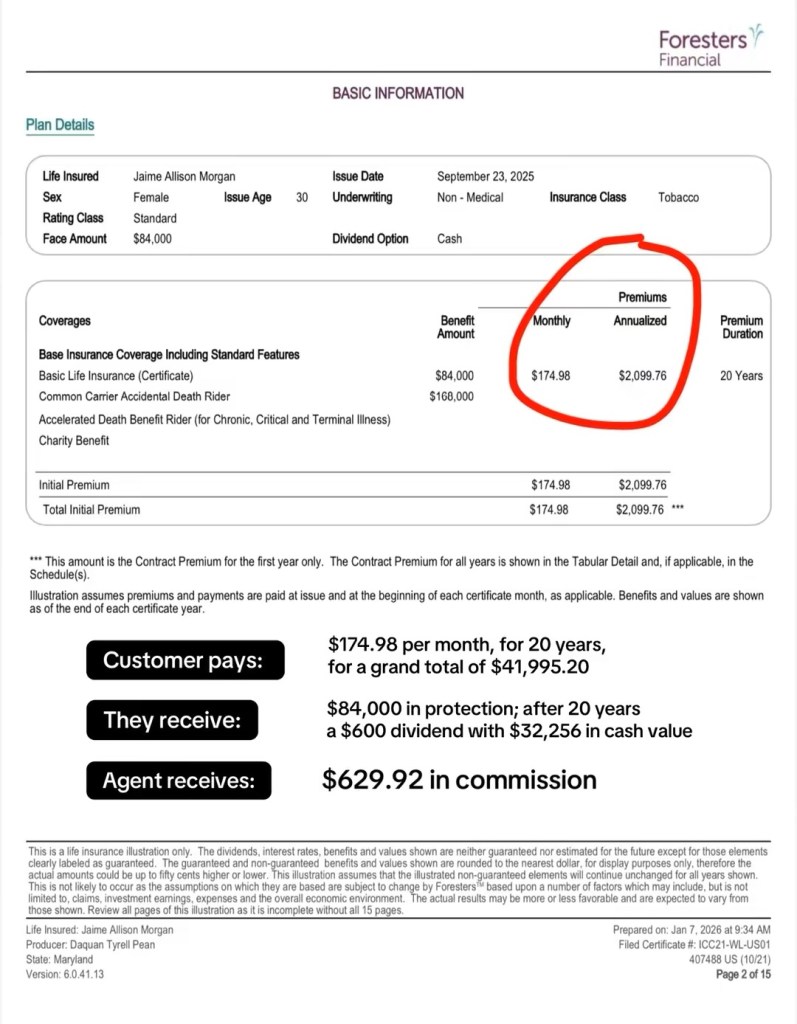
I spent some time practicing presenting insurance illustrations, including working with Zoom, Docusign, and the application portal. This is after cutting ties with my previous Marketing Director and endeavoring to become more independent.
The secret to presenting insurance illustrations is two fold, the first is about condensing the illustrations into the following:
- What the client pays and how often
- What the client receives in exchange for their payment
- What the agent would receive in commission, assuming they were entry-level, what they would receive as a Marketing Director (MD), and what the Marketing Director would receive as an override.
All that being said, while I’ve made some great process on how far I’ve come as an insurance agent, I’ve still got a long way to go.
 🩸
🩸 
Leave a comment