A History of Blood – Vol. 1, Chapter 1
This year, the 9th of Av fell on August 3, 2025, which also happened to be my mother’s birthday. My mother and I speak regularly, but it’s been years since I’ve seen her in person. Naturally, my mother and I have things in common, but we are separated by our differences. As adults, we have never seen each other eye to eye, and we likely never will, as was the case with her and my grandfather, whom I have never actually met.

Introduction and Backstory
The United States occupation of Haiti began on July 28, 1915, when 330 US Marines landed at Port-au-Prince, Haiti, after the National City Bank of New York (Citibank) convinced the President of the United States, Woodrow Wilson, to take control of Haiti’s political and financial interests.
During the occupation, Haiti had three new presidents while the United States ruled as a military regime through martial law, led by Marines and the Gendarmerie.
A corvée system of forced labor was used by the United States for infrastructure projects, resulting in hundreds to thousands of deaths. Under the occupation, most Haitians continued to live in poverty, while American personnel were well compensated. The American occupation ended the constitutional ban on foreign ownership of land, which had existed since the foundation of Haiti.
The occupation ended on August 1, 1934, after President Franklin D. Roosevelt reaffirmed an August 1933 disengagement agreement. The last contingent of marines departed on August 15, 1934, after a formal transfer of authority to the American-created Gendarmerie of Haiti.
The Gendarmerie of Haiti (French: Gendarmerie d’Haïti), also known as the Haitian Constabulary, was a Haitian gendarmerie (or military-style police) born and raised during the United States Occupation of Haiti.
Established under U.S. military guidance, the gendarmerie was operational from 1916 until 1928, during which time it was Haiti’s only military force, earning a reputation for active interference in civilian government that may have set the stage for the future politicization of the Armed Forces of Haiti. From 1918 to 1920, the gendarmerie fought in the Second Caco War. It was reorganized as the Haitian Guard in 1928, forming the nucleus of what would evolve into the modern military of Haiti.
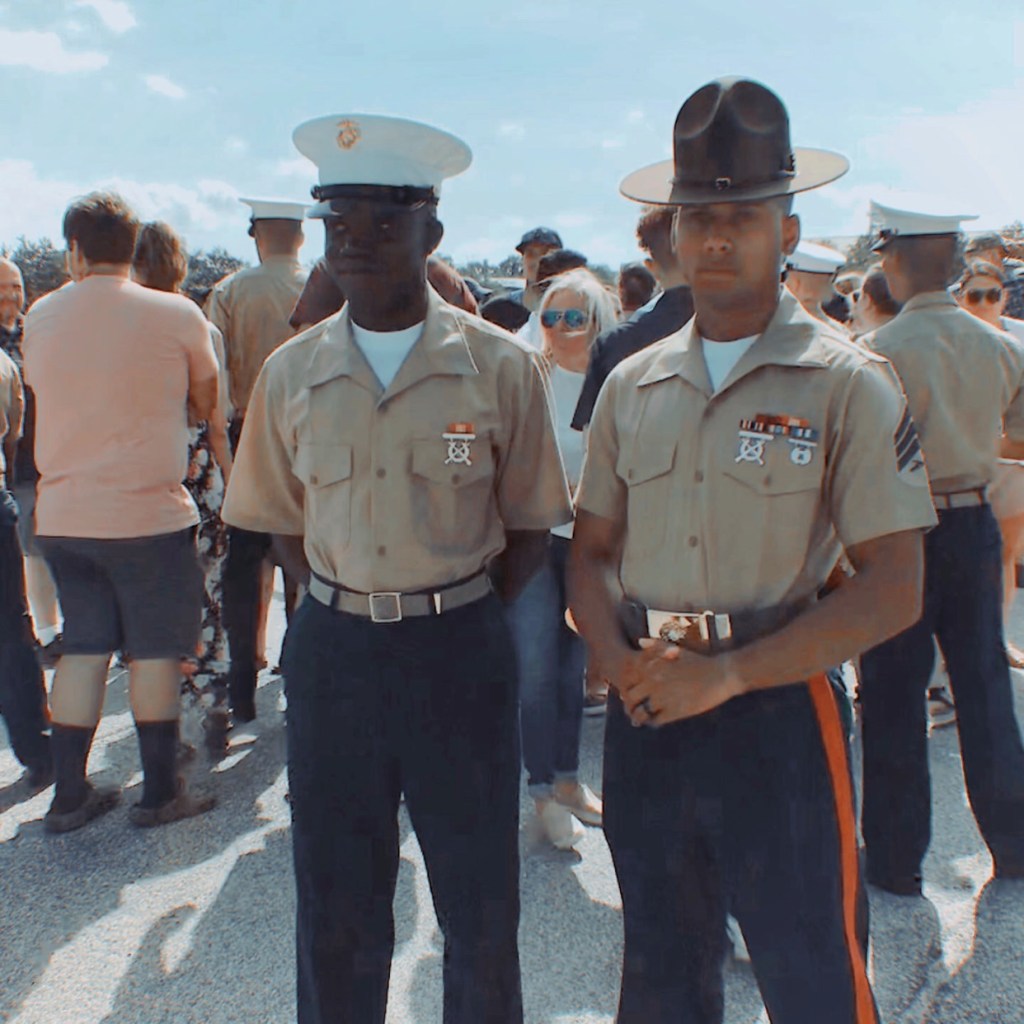
My Story
My Story formally begins at the picture above, featuring Private Pean (me) on the left and Sergeant Beavers III on the right.
It was taken by my adoptive mother, on June 24, 2022, which was both the day I graduated Recruit Training and the day I earned the title of United States Marine. Once you are a United States Marine, you are always a United States Marine, and you keep your rank and title for all eternity, regardless of whether or not you are active duty at the time of your death, disability, or retirement.
I didn’t really know too much about the History of the Marines before I enlisted, and I knew even less about the History of my family. As a Private, with no military connections, I genuinely struggled to adapt to military life, especially with how quickly it changes, how deceptive it is at times, and how abusive it is at others. These struggles continued even after I was promoted to Private First Class.
When I joined the Marines, I literally knew nothing of my family history. I grew up in foster care and after I was adopted, my records were sealed, and I was fed lies by my foster family with no real way to find out the truth. The depth of some of these lies has caused me to lose sleep on some nights, but it’s given me a greater appreciation of the truth, a greater appreciation of what I do for a living, a greater appreciation for the people who helped me find out the truth, a genuine sense of peace on most nights, a sense of purpose most of my days, and higher calling when it comes to both my military and civilian careers, both of which are just getting started.
I am extremely grateful the Marines gave me an opportunity despite not knowing who I was, but it’s possible they knew who I was and saw the potential, while affording me the time and resources to figure things out on my own.
I was born Daquan Tyrell Pean, in Manhattan, New York, on March 16, 1992 to Danielle Pean, the daughter of Yves Pean. Yves Pean died in Brooklyn, New York, on October 13, 2019. The three of us make up a History of Blood.
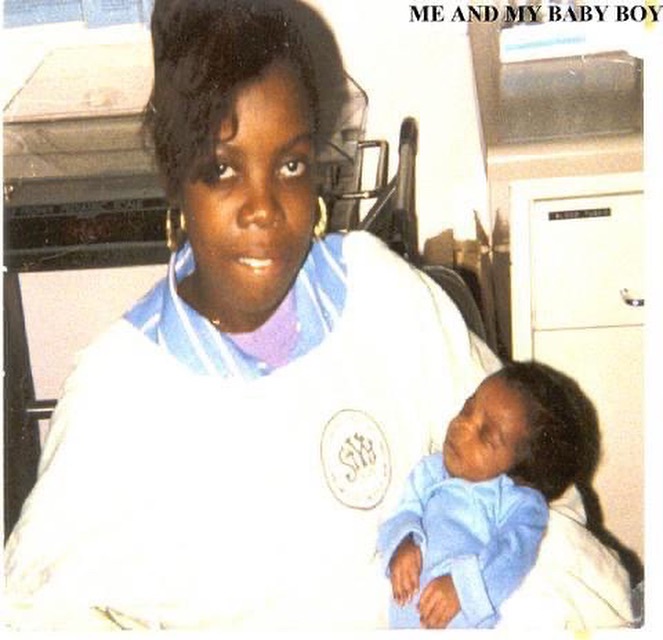
Danielle Pean was born in Port-au Prince, Haiti, on August 3, 1976. She came to the United States in the year 1988, following the rest of her family, whom did not all come to America together.
Yves Pean was born on October 13, 1947, somewhere in the countryside of Haiti. He came to the United States in the year 1979 or so, leading the way for the rest of his family, or leaving behind the rest of his family, depending upon your perception of him and the events.
It’s worth noting that at the time my grandfather, Yves, came to the United States, Haiti was under the totalitarian rule of the Duvalier Dynasty. My mother did not have the best impression of her father, but considering she was a child when she came to the United States, and considering her limited education at the time, it’s unlikely she understood the complexity of the situation at the time.
I experienced something similar when I was forced to change my name and leave my hometown of New York with the woman whom adopted me.
On September 11, 2001, I was 9 years old. I remember the day very vividly. While the day started off pretty normally, it would slowly creep into eerie territory, as all the children in my elementary school classroom left one by one.
I was a diligent student as a child, I wore my uniform properly, I volunteered whenever I could, I was largely quiet, and mostly well-behaved, so all I did was observe and wonder if my own family was coming.
My adoptive mother came to pick me up later in the day, and I ended up leaving school early like everyone else. No one was saying anything. I had no idea what I was watching on the television when I got home, all I knew was that it wasn’t cartoons.
 🩸
🩸 
Leave a comment